Friday, April 9, 2021

Being a Part of the Solution

Recently the GBMC HealthCare system increased the minimum hourly pay rate for employees to $15 per hour along with providing employer-paid short-term disability insurance (40% of base earnings up to $695 a week). We are in a very tight labor market, so making our company more attractive to workers makes good business sense. An even better reason to make these changes is because it is the right thing to do for our employees. 

There are many hard-working people in our community who are struggling to make ends meet. We hope that raising the minimum wage to the living wage for Maryland will help. GBMC is also happy not to increase the employee’s portion of the health insurance premium for our platinum plan again for fiscal year 2022. This, too, is a benefit to all of our people. 

Despite the financial and operational challenges brought on by the COVID-19 pandemic, our decision to increase the minimum wage, offer employer-paid short-term disability, and hold constant the employee’s contribution to health insurance costs are evidence of our commitment to our people and of the attention we pay to the results of the employee engagement survey. Please complete this year’s short survey if you have not done so already! The survey is open until this Monday, April 12, and is completely CONFIDENTIAL. We cannot identify individual responses. If you do, however, choose to include additional comments, these will be shared with your manager. Your name will not be given. Thank-you.

Flag Raising Ceremony
Every ten minutes, a person in the United States is added to the national organ donation waiting list. One person’s donation can make a huge difference for the people on this list. A single tissue donor has the potential to improve the lives of 50 people and one organ donor can save up to eight lives!

April is Donate Life Month, which brings awareness to the need for organ and tissue donors and honors those who have already donated. Earlier this week, I was privileged to be part of a very special event at GBMC. In partnership with The Living Legacy Foundation of Maryland, we held a flag raising ceremony to honor the memory of donors and celebrate their gifts of life to others.

Please remember that you have the power to save lives. April is the perfect time to register as a donor if you haven’t already. Those wishing to register as an organ, eye, and tissue donor can do so at the MVA or at www.donatelifemaryland.org .

Thursday, April 1, 2021

What do you think about the GBMC HealthCare System as an employer?

This week, we began the 2021 Employee Engagement and Safety Survey that is brought to us by the Gallup Company. It is very important for us to hear from our people about how the company is doing as an employer. It has been a tough year for all of us with the pandemic, the cyberattack, and labor shortages. We have not had the time to focus on many issues outside of these emergencies; however, GBMC has worked hard to keep our people financially and physically safe. We take the survey results very seriously. This year, we worked hard to avoid furloughing people and added short term disability insurance as a benefit – in large part because of input from last year’s survey. 

Please complete the survey. It is CONFIDENTIAL. We cannot identify individual responses. If you do, however, choose to include additional comments, these will be shared with your manager. Your name will not be given. Thank you for helping to identify opportunities for further improvement, to judge the value of changes we made since the last survey, and to make GBMC an even better place to work and a safer health system for all. 

National Doctor’s Day
March 30th (this past Tuesday) was the annual Doctor’s Day celebration. On this day, we thank physicians for their commitment to serving those in need. During a year with an unprecedented public health crisis, we have seen bravery, commitment, teamwork, flexibility, and dedication from GBMC physicians. 

We thank all the surgeons, hospitalists, ED physicians, primary care doctors, and specialists throughout GBMC for all that you do every day to help GBMC move toward our vision: To every patient, every time, we will provide the care that we would want for our own loved ones.

Celebrating Women’s History Month
On Wednesday, we completed the celebration of Women’s History Month, an annual declared commemoration that highlights the contributions of women to our society. GBMC HealthCare thanks the women on our team who have served our community since our inception. 

Lisa Walker, our Director of Learning and Organizational Development, Diversity, and Inclusion, and her team put together a series of videos of some of the amazing women at GBMC who deserve to be recognized not just in March, but throughout the year. Click here to view the videos. 

Denouncing violence against the Asian, Asian American, and Pacific Islander Community
We stand united in solidarity with those opposed to the recent episodes of anti-Asian racism and violence. GBMC HealthCare denounces the horrific incidents in Atlanta, GA, and the recent loss of life in Boulder, CO. We are stronger when we embrace everyone. GBMC re-commits to equity, diversity, and inclusion for our workforce and communities we serve.  

Happy Passover and Easter
This is a week of religious reflection and celebration, and the GBMC HealthCare family sends its best wishes to our Christian staff members celebrating Easter this Sunday as well as our Jewish staff members observing the eight-day festival of Passover. For GBMC staff members working during their spring holiday, special thanks for taking care of those who are ill during this time. I am grateful for all your efforts. 

Friday, March 26, 2021

Moving Proximate

The GBMC HealthCare System realizes that we must be a part of the healthcare equity solution. We are building a new home for the Gilchrist Center Baltimore at Stadium Place to continue to give disadvantaged residents of Baltimore the same access to outstanding end-of-life care that the rest of us have. We moved into Baltimore City, at the Helping Up Mission (HUM), our inner-city primary care center, to aid the residents of that program and to provide advanced primary care to members of the community. 

The growth at HUM, has been slow, in large part, due to the pandemic. But this week I got great news from Erlene Washington, our Vice President for Physician Practice Management and Chief Operating Officer of GBMC HealthPartners. Amerigroup, the Medicaid serving HMO, has let us know that the number of their members in our practice has grown to 1,100!

Those insured by Medicaid often have difficulty finding doctors. Physicians in private practice rarely take Medicaid because the fee-for-service payments are too low for them to cover their costs. So, those on Medicaid are usually only left with hospital-based clinics that have limited hours and long waiting periods for appointments.

Our practice on East Baltimore Street is welcoming everyone in the community. We are providing advanced primary care there because we believe that everyone deserves the care that we want for our own loved ones. I am so grateful to Ericka V. Easley, MHA, Senior Ambulatory Practice Manager, and James Baronas, MD, Medical Director, for getting us to this point. It is our intention to learn from this practice, work with partners like Amerigroup, reduce waste, and change the payment system. We will then work towards adding other sites within the city. We must get proximate to the problem to be a part of the solution!

Friday, March 19, 2021

A Focus on Safety is a Prerequisite to the Best Health Outcomes

This week is Patient Safety Awareness Week (March 14-21). During this week in the U.S., we have a national education campaign for promoting patient safety practices. At GBMC, we commit to achieving the best possible health outcomes for our patients and we know that we cannot do this without developing highly reliable systems that prevent harm to those in our care.

Students of safety know that atypical situations create higher risk of harm. The COVID-19 pandemic is one such atypical situation and therefore it is even more important this year to draw attention to patient safety work. 

For the past year, our physicians, nurses, and other clinicians have stood up against the pandemic while being alert (preoccupation with failure) to new potential causes of harm. One of these potential causes has been the absence of visitors. During usual times, family members at the bedside often bring forward important information for their loved one’s care. Our teams have had to redesign the system of including the family in the patient’s care by doing things such as using MyChart bedside for video meetings. Then with the cyberattack, we added safety nurses to our units for double checks that are usually done by our computer systems. 

I am so proud of how our people have used our core competency of redesigning care to keep our patients safe during the pandemic and the cyberattack. 

Our patient safety measures were tested once again last Friday. You can imagine the thoughts that were racing through my mind when I got the call that we were experiencing another IT outage. Luckily, the outage was not the result of a malicious attack but was due to an electrical failure in our main data center. Thanks to the hard work of Jim Keyzer, CHFM, our Director of Facilities, Mitchell Scholtes, Assistant Director of Facilities Operations, and their team, our systems were restored after several hours, and we were back to standard operations. I also want to thank Dave Hynson, GBMC’s Chief Information Officer, and his team for doing their part to help get our systems functioning again.

It is in these times of crisis that we must redouble our efforts to create highly reliable systems. The hard work and good intentions of our well-trained people are necessary but insufficient to achieve our vision. It is also critical that we work in highly reliable and well-designed systems with significant redundancy. We need redundancy to prevent catastrophe and recover from the failure of a specific piece of the system. 

Our patients trust us to care for them in their most vulnerable moments, and it is our duty to provide them with the best possible health outcome, which presupposes that we won’t hurt them. This week, please take the time to reflect on what we are doing to improve patient safety and to celebrate the amazing work we have done in the past year.

THANK YOU!!!
March has been designated as Professional Social Work Month, and this week also happens to be Human Resources in Healthcare Week (March 15-19).

Our social workers are critical to our work in identifying and mitigating issues with an individual patient’s social determinants of health like lack of insurance, homelessness, and food insecurity. Our human resource professionals work hard to develop policies to recruit and retain great people for our team. Both groups have faced significant challenges brought on by the pandemic. 

Please take the time to thank our social workers and our human resources staff for all that they do to move us closer to our vision!

Friday, March 12, 2021

A Great Example of How Team Training Using Simulation Improves Outcomes and adds Joy

Healthcare is a high-risk industry – just like commercial aviation and nuclear power. Unlike these other two high-risk endeavors, healthcare has only recently learned the importance of training as a team in a controlled, safe environment. 

When I was a resident physician a few decades ago, the adage was “see one, do one, teach one.” I was involved in many high-risk events like resuscitating a newborn baby or doing a total volume blood exchange on a sick premature infant. Generally, I was allowed to do these procedures without supervision after seeing one of them done. The notion that I should train to do the procedures with the teammates who would be assisting me was a foreign concept. There was very little discussion about the risks to the patients of having a relative novice do the procedure. It was assumed that I knew what I was doing and that I would be vigilant. 

I am so glad that things are not like that anymore. Healthcare now understands what commercial aviation has known for decades. When lives are at stake, competency and readiness cannot be taken for granted. In addition, we now recognize that no one person can do everything and that no one is perfect. We need teams! At GBMC, we are blessed to have a state-of-the-art Simulation Center – just like pilots and co-pilots train in – so that individuals and teams can practice. This way, when the time comes, they are ready. Every procedure has risk, and we want to know that what should happen, happens, and what should not happen, doesn’t. This is the definition of high reliability. 

Recently, I was told a story that made me very proud and underlined just how far we have come in our quest for the highest level of patient safety and high reliability. 

A few weeks ago, we had a very busy day in our intensive care units. The units were close to full capacity as we had an influx of patients from our Rapid Response Team (RRT). One of these patients had a very low heart rate at 60 beats per minute and was going in and out of consciousness. During the three second pauses between beats, the patient’s eyes would roll back, and he would become unresponsive.

David Vitberg, MD, our Director of the Division of Medical and Surgical Critical Care, along with ICU nurses Michelle Braun, Lauren Walsh, Erin Saunders, and Mike Porter, jumped into action. With the support of his team, Dr. Vitberg inserted a sheath and transvenous pacer. Within a few minutes everything was complete. The pacer wire was in, the patient was being paced at 70 beats per minute, and thereafter he remained completely stable. The team was elated. They had smoothly and effectively performed a life-saving procedure. It was a procedure that they do very infrequently, but because they had trained to do this in the simulation lab as a team, it went off without a hitch. 

Dr. Vitberg told me that “It was spontaneous, authentic, mutual happiness for our patient and our team. The success of saving a man’s life felt great! We all knew something special had happened and we all knew "why.”

This man is still living today in large part due to the interdisciplinary simulation training where Dr. Vitberg and his ICU team practiced the insertion of a transvenous pacer. 

I’m so proud of these ICU colleagues for their teamwork and I am grateful to our leaders Dr. Vitberg and Nurse Manager, Rachel Ridgely, RN, and to Deborah Higgins, RN, MS, Manager of the Simulation Center, and to Dr. Donald Slack, Director of Medical Education of the Simulation Center, for seeing to it that training happens and that team learning is achieved. 

Turning blue to raise awareness
You may have noticed the blue wall lighting coming down the concourse from the Lily Garage into the hospital and a shade of blue shining on our main sign on Charles Street. This was done, in conjunction with the American Cancer Society (ACS), Colon Cancer Coalition and Fight Colon Cancer, to shine a bright light in recognition of Colorectal Cancer Awareness Month to support patients, increase awareness, raise screening rates, and save lives. 

Colorectal cancer is the second leading cause of cancer death in the United States and the third most commonly diagnosed cancer in both men and women. Unfortunately, ACS statistics show that due to COVID-19, colonoscopies declined nearly 90 percent in April 2020 from the previous year, which could result in an additional 4,500 deaths from colorectal cancer in the next 10 years. If you are due for one, please make sure that you schedule your colonoscopy as soon as possible Colon cancer is one of the few cancers that can be prevented through timely screening and removal of pre-cancerous polyps.

I want to thank Brian Fitzpatrick, our Energy and Facilities Manager, and his crew for their work in turning our lights blue. I hope it encourages people to get screened when they are due!

Friday, March 5, 2021

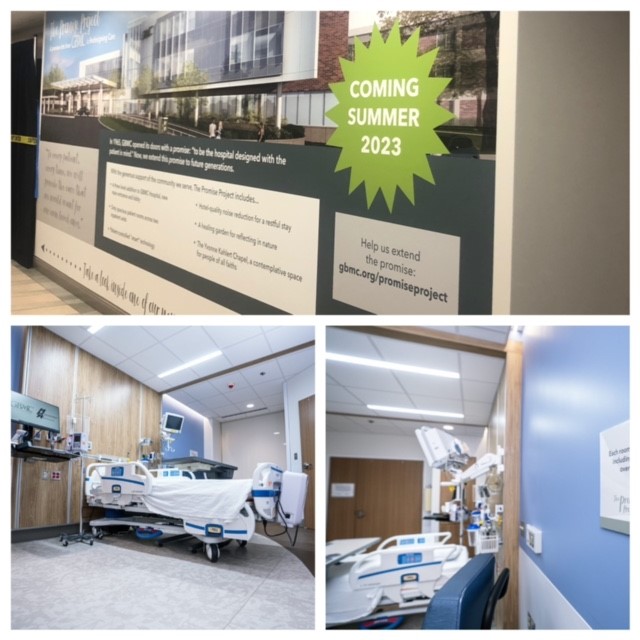
The Big Reveal of Our New Patient Room

Over the last couple of weeks, the question “what is going on?” has been echoed by many visitors and staff as they walked through our main lobby. One visitor jokingly asked one of our employees, “Is the Wizard of Oz hiding in there?” There was no wizard – it was a mockup of the future of inpatient care at GBMC.

On Tuesday, the mystery of what was behind the curtain was solved, as I was joined by Dr. JoAnn Ioannou, DNP, MBA, RN, NEA-BC, our Executive Vice President for Hospital Operations and Chief Nursing Officer, and Stacey McGreevy, CPA, our Vice President of Support Services, for a LIVE virtual tour of the full-scale model of one of our new Promise Project patient rooms! The Promise Project is a three-story hospital addition which will feature 60 spacious patient rooms across two inpatient units, a modern lobby and reception area, healing garden, chapel, and more. 

We have been in the design and planning phase for over a year, and many disciplines have been involved. The mockup was built to showcase the new room design and to generate excitement about the project as we get ready to move to the public phase of fundraising. 

The new rooms will be quite spacious (double the size of our current rooms) to more appropriately accommodate patient and clinical staff needs and will have advanced sound proofing to facilitate the rest and healing process. Other improvements include more storage for patient belongings and a new bathroom that is ADA compliant, allowing for easier use by all patients. 

One of the biggest improvements in the rooms is a result of lessons learned from the COVID-19 pandemic. The unit design will provide us with the ability to make each room a negative pressure room, which will help us protect against infectious diseases. We will be the only hospital in Maryland to have units with this ability. 

I am very proud to be at the forefront of innovation with our new patient rooms that will support the extraordinary work of our physicians, nurses, and other staff. This is an investment to move us closer to achieving our vision – to every patient, every time, we will provide the care we would want for our own loved ones. I encourage you all to visit the model of our future patient rooms and to finally get a look at what was behind the curtain!

COVID-19…One year later
March 5th marks the one-year anniversary of Governor Hogan announcing the state’s first cases of COVID-19 and declaring a State of Emergency. Since then, hospitals and health systems began battling COVID-19 as cases spread across our state. 

I continue to be grateful to our entire GBMC team for all they have done to stand up to the virus. We still have work to do, but the pandemic is abating thanks to good hand hygiene, social distancing, the wearing of masks, and people getting immunized. 

I am also grateful to our patients and the communities we serve, for their unwavering support and commitment to GBMC. Whether it was donating masks, providing food to our front-line workers, offering prayers for our team members, or acting in other ways, big and small, to show their gratitude and their care for our people, it has been truly inspiring. Thank you!

Friday, February 26, 2021

A Conversation with an Outstanding Baltimore Couple

Every year, GBMC celebrates Black History Month. Over the past few years, the need to truly celebrate the achievements of Black Americans and commit to work for social justice has become more important than ever. We have seen far too many episodes of racial injustice across our nation. I think getting to know each other is the best way to begin to bring people together. Every February, we take time to learn about African American history, culture, and the outstanding achievements of Black Americans that often go unrecognized. 

On Thursday, I had the privilege of serving as the host for a virtual celebration with UMBC President Dr. Freeman A. Hrabowski, III, and Mrs. Jacqueline C. Hrabowski. Dr. Hrabowski became the president of UMBC in 1992 and was named by President Barack Obama to chair the President’s Advisory Commission on Educational Excellence for African Americans. Dr. Hrabowski has also been named one of the 100 Most Influential People in the World by TIME and one of America’s Best Leaders by U.S. News & World Report. Mrs. Hrabowski is the former Vice President of Corporate Community Involvement at T. Rowe Price, and is a passionate community volunteer and advocate in her own right. 

I truly enjoyed my time interviewing the Hrabowskis. As I said to them during the interview, they are so accomplished as individuals and I was very impressed with their dedication to helping others. Their joy “jumped” through the screen. It was an exceptional chance to discuss their personal stories along with our theme for Black History Month, that we carried over from our Martin Luther King Jr. Day Celebration this year: “Getting into Good Trouble-Restoring and Uniting Humanity” based on the mantra of the late congressman John Lewis. It was also an opportunity to discuss the accomplishments of African Americans in our nation and locally. You can watch the video here.

Our Black History Month celebration honors the marvelous accomplishments of the many great African Americans whose work impacts our daily lives. It was my honor and pleasure to host this event and I want to express my appreciation to Dr. and Mrs. Hrabowski for joining us. I am grateful to my colleagues on the Diversity and Inclusion Council and our Black History Month Committee for putting together an outstanding celebration and helping bring us together. I want to also thank The Baltimore City College Choir for their wonderful performance. Thank you!